
Care as Resistance: The People Supporting Thailand’s Political Prisoners
Written by Sutavee Thaivanich
Since the 2020 pro-democracy protest, hundreds of activists, students, and regular people have been charged for criticizing the monarchy under Article 112 of the Criminal Code, also known as lèse-majesté law. This law makes it illegal to defame, insult or threaten the king, the queen, the heir apparent, and the regent, and carries a sentence of up to 15 years per count. A single online post can simply put you in jail.
Most news coverage focuses on laws and the courtroom, but this does not tell the world about the deeper human cost that comes with legal prosecution. How do political prisons’ families survive when their breadwinners are put in jail? How does someone hold themselves together through years of trials and uncertainty about whether they will get to go home? The Thai judicial system leaves many struggling to fend for themselves.
This is a story about the people who try to fill those gaps. Freedom Bridge is an organization that helps political prisoners go through legal prosecution with dignity. Meanwhile, Justice in Translation does something harder to categorize: it takes the words of political prisoners, who manage to write statements and letters from inside their cells, and carries them across the language barrier that would otherwise keep their voices from reaching the rest of the world. Together, these two initiatives represent something that discussion of authoritarian repression rarely examines: resistance not as confrontation, but as care. The work of making sure people survive long enough to keep fighting in the long-term is crucial to a sustainable popular movement.
Thai Prison Conditions and Impacts
Before going further, it helps to understand what life in a Thai prison actually is like. According to Thailand: Annual prison report 2025 by the International Federation for Human Rights, conditions still have much room to improve: overcrowding, inadequate hygiene and food, limited access to mental and physical healthcare, and inhumane forms of punishment and disciplinary procedures are still reported. Still, conditions vary across prisons, as some may be better than others. Political prisoners live under the same conditions, but what sets them apart is not the physical environments. Instead, it is the additional weight that they have to carry: the feeling of injustice that they did nothing wrong and do not deserve to be in here.
That weight extends beyond the individual. As Pathomporn Kaewnoo, the Founder of Freedom Bridge describes, “when someone in the family is put into jail, the whole family is affected by that, too, especially when the person jailed is the breadwinner.” This is because the loss of income is immediate and the spouses may have to take on responsibilities they never meant to carry alone. On top of that, family ties are further strained by the hoops people have to jump through to do something as simple as sending a letter to their imprisoned loved ones. Prison staff screen all letters, and whether a letter gets approved depends entirely on the discretion of the officer on duty. There is no consistent standard and no appeal.
“One time we sent a picture of a sunflower, but it was rejected because pictures in approved letters could only be of humans. We had sent another picture of a flower before, and it got approved. And we could not appeal this decision as their discretion is considered final,” explained Pathomporn.
There are two ways to send letters: through the post office or online. For the online system, each letter costs 10 Thai baht, or around 30 cents. However, the prison sometimes stops selling letters altogether, citing a lack of staff to screen them.
“Even when you have money, you cannot even communicate with the outside world,” said Pathomporn.
Impacts of legal prosecution remain even after political prisoners have been released from prisons. A criminal record follows them when they try to find a job, hindering their likelihood of being employed, because many employers immediately refuse to hire anyone with a criminal record. In terms of mental health, some former prisoners keep having nightmares or live in a constant state of paranoia, wondering whether they still have a Facebook post somewhere that could put them back to jail.
Freedom Bridge
When the state decides someone is an enemy, it does not only lock them up physically but also cuts them off from income, family, and basic things of daily life. As Nattamon Supornvate, the Program Coordinator of Freedom Bridge, put it: “In Thailand, there are a lot of human rights organizations that focus on communication but rarely fill the gap for political prisoners experiencing these prison conditions.” Freedom Bridge was founded to be that exception.
The organization was founded in response to the wide arrests and imprisonment of activists and movement leaders in the wake of the 2020 pro-democratic protest. Watching prison conditions worsen, Founder Pathomporn saw a need that nobody else was meeting. “We wanted to make sure that even if someone is sentenced to 20-30 years, at least their quality of life would remain dignified—not living in deprivation, forgotten, with no one looking out for them. We wanted to support their fight.”
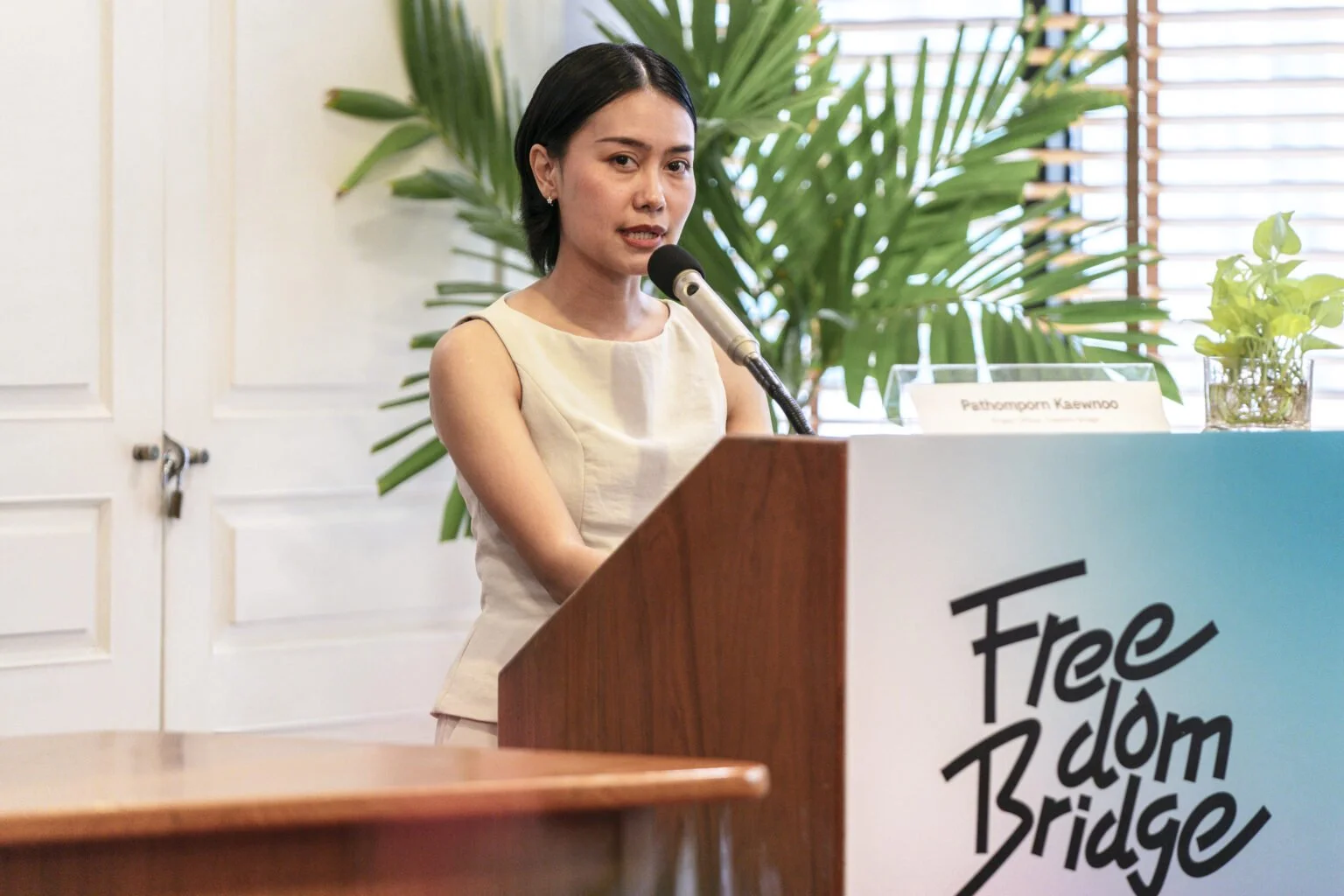
Pathomporn Kaewnoo, Founder of Freedom Bridge
Freedom Bridge’s work is mutual aid in practice—not charity flowing from the powerful to the powerless, but solidarity between people who understand they are part of the same struggle. Their work simply started with buying food and basic supplies to send into prisons, because such basics are not guaranteed there. However, the longer Freedom Bridge operated, the more it became clear that the needs ran much deeper. Many political prisoners have young children, so the organization began to send their families diapers and baby formula every month, enough for one month at a time. It covers prisoners’ medical costs that fall outside Thailand’s universal healthcare, including hormone treatment for transgender people, glasses, eye surgery, and dental braces. These are not luxuries. Rather, they represent the difference between a life lived with basic dignity and one spent in slow deterioration.
Moreover, distance can make family visits unaffordable. Some families live so far away from the prison that traveling there can cost as high as 10,000 baht per month, or over 300 USD. Additionally, regular visits are capped at 15 minutes, which is barely enough for families to check on their loved ones and let alone offer any real support. Because of these obstacles, some families stop visiting their imprisoned loved ones altogether. To mitigate these barriers, Freedom Bridge helps cover travel costs for special 2-hour close family visits, which prisons allow 2 or 3 times a year.
Justice in Translation
Besides Freedom Bridge’s material mutual aid work, there is another initiative that tries to address another kind of isolation—one built not out of bars, but out of language. All the court's decisions, statements, and letters by political prisoners are written in Thai, which remains sealed inside a language barrier that functions, in its own quiet way, as an extension of the prison itself. Justice in Translation, part of the Justice in Southeast Asia Lab at the University of Wisconsin-Madison, attempts to break that seal. It publishes English translations of documents that would otherwise never reach an international audience: court decisions, poems, essays, or letters. Among the most notable are the letters by Arnon Numpa—a human rights lawyer imprisoned under Article 112. What holds them together, as Professor Tyrell Haberkorn describes it, is a single thread: they are all related in some aspect to justice or injustice in Southeast Asia.
Professor Haberkorn, Plaenert-Bascom Professor of Southeast Asian Studies at the University of Wisconsin-Madison, and board president for Engage Thailand, has been doing this work since 2011 alongside other translators who contribute to the project. The question that naturally comes up is: Why translate, rather than simply write about it yourself? The answer is straightforward: “I don’t think the world needs another analysis. Their words matter tremendously because they are living an experience that so few people are,” answered Professor Haberkorn. The letters also carry a credibility and weight that no secondhand account can replicate. This is direct evidence, in the prisoner's own words, of what it really means to live inside that injustice.
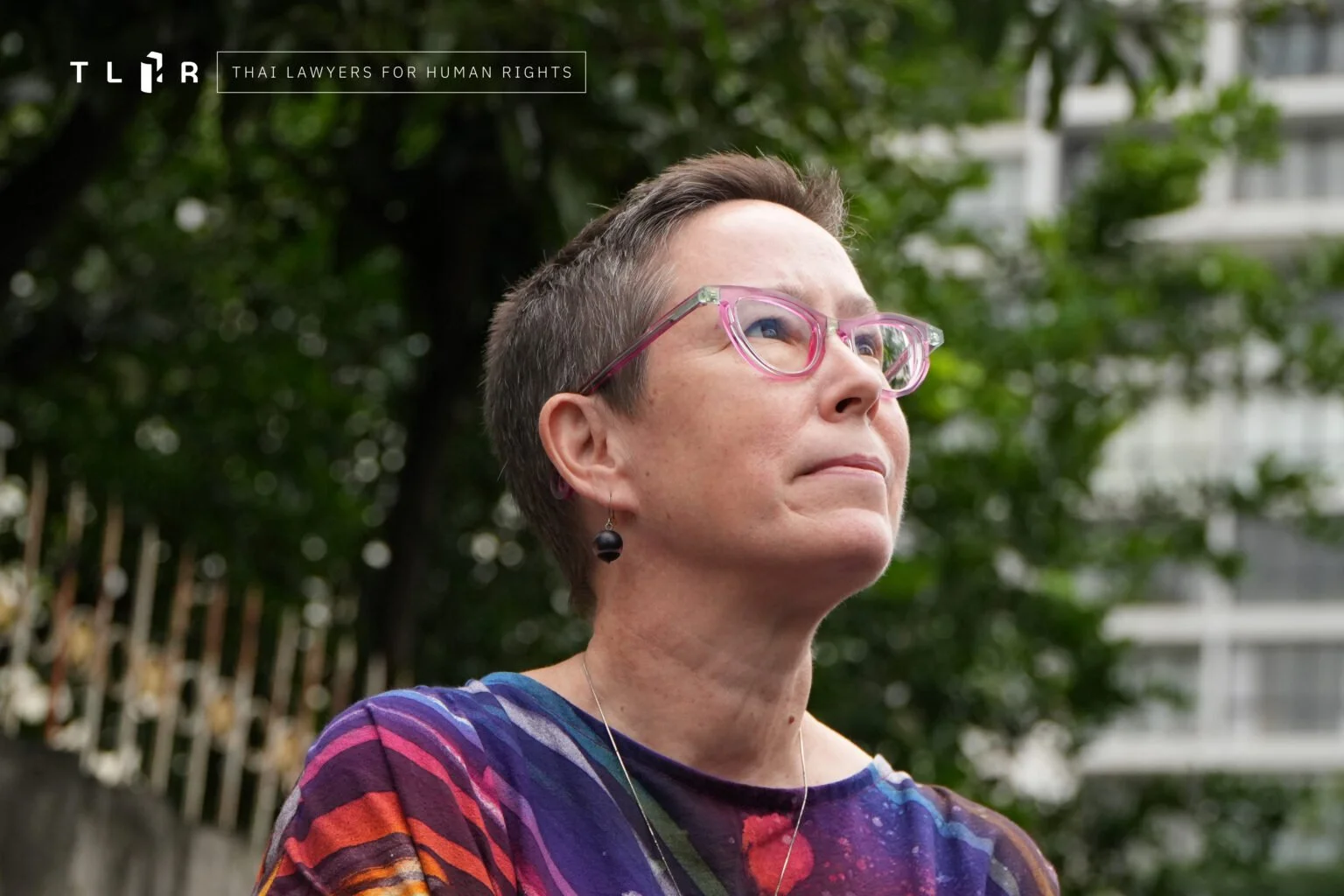
Professor Tyrell Haberkorn, Justice in Translation
Professor Haberkorn has seen the impact of such direct evidence in her teaching. “There’s always sort of an element of shock,” she says, describing the first reaction of a reader unfamiliar with Thailand in learning that someone is in prison for decades for peaceful speech. What follows the shock, consistently, is something closer to humility: readers are moved by courage and persistence they encounter in the specificity of the daily life described in the letters, the ache of separation from their children, and the account of time passing.
When asked about the goal of the project, Professor Haberkorn’s answer was simply the most basic one: awareness. People will read and realize what no statistics or legal analysis quite achieves: how profound the effects of lèse-majesté are, as well as how extraordinary the people living under its subjugation are.
What You Can Do
The realities of this unjust legal prosecution are impossible to ignore. A photo of a sunflower can be rejected at the prison gate, not because of any written rules, but because of the prison guard’s discretion on one particular day. A political prisoner who wants to communicate with the outside world is not always able to. Even after release, their criminal record follows them into the job market while nightmares of captivity haunt their sleep.
However, none of this is happening without people deciding to show up and help. Freedom Bridge and Justice in Translation emerged from people who saw a gap and refused to walk past it. That is an invitation to the rest of us. The struggle they are sustaining needs the world to pay attention, and paying attention is something anyone can do.
For those who want to be part of these efforts, there are simple ways to help. Freedom Bridge accepts donations, which will go directly toward food, medicine, family visits and psycho-social support for political prisoners and their families. Justice in Translation’s archive of translated letters, court decisions, and statements is freely available online to read, share, and teach with. Reading these and sharing them with a friend, a professor, or a policy maker is itself a form of resistance you can participate in—so is simply saying the names of people the Thai state would prefer you forget.
